Hospitality Systems

Investigating and enhancing digital table management tools for high-stakes restaurant services.
Project Overview
Restaurant staff often struggle with managing the pace of service using digital tools during high-stakes service periods. As part of my eCornell UX certification, I investigated the operational impact of table management platforms such as ResyOS and OpenTable.

Timeline
8 weeks / February 2026
Role
UX Researcher & Designer
Scope
eCornell UX Certification / Academic Portfolio
Tools
Figma, Paper Prototypes, Affinity Mapping
Design Problem Statement
Restaurant staff using hospitality platforms need a way to overcome fragmented communication during high-intensity shifts to reduce burnout, as these gaps lead to interpersonal tension and a measurable decline in service quality.
Empirical User Research
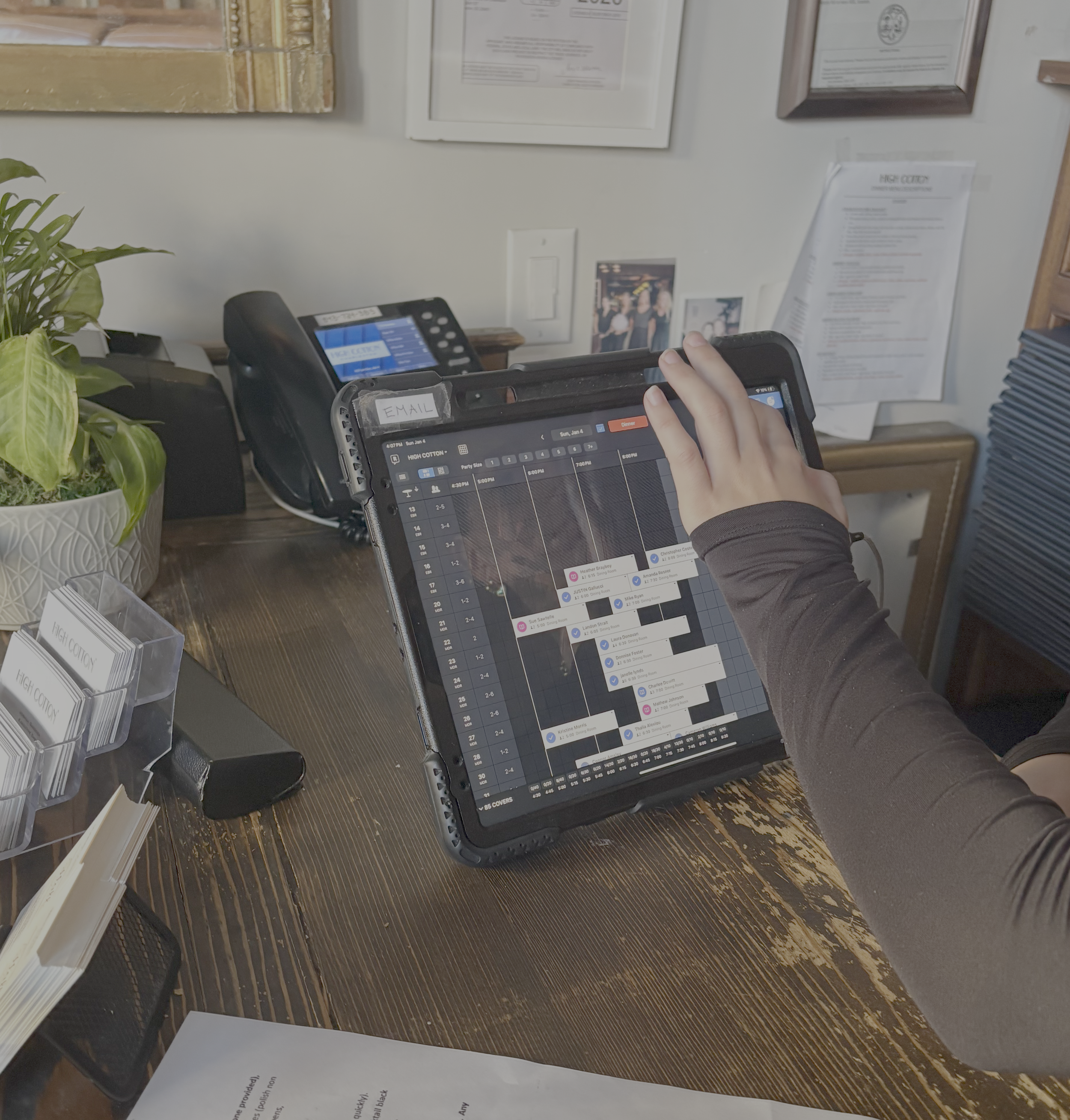
Contextual Inquiry Methodology
Developed a formal methodology to guide research.
Restaurants can be fast-paced, high-stakes environments
Contextual Interviews focus on how environments influence user interaction
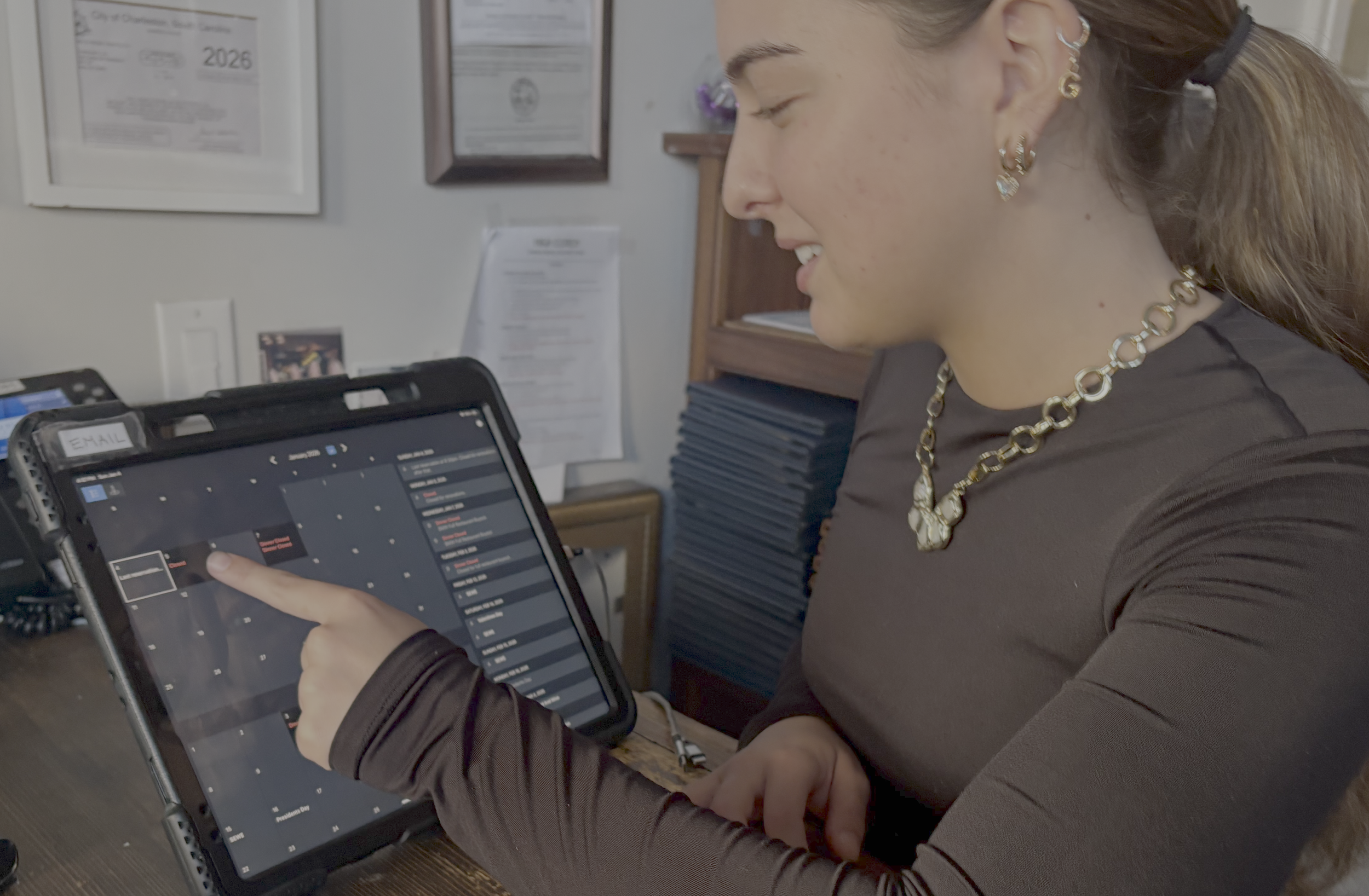
Recruitment & Protocol
Disseminated a recruitment message to gather participants and employ my interview protocol.
The message conveys participation requirements, outlines involvement, and discusses confidentiality.
The protocol consists of Introduction, Background Questions, Core Questions, Tour, and Closure sections.
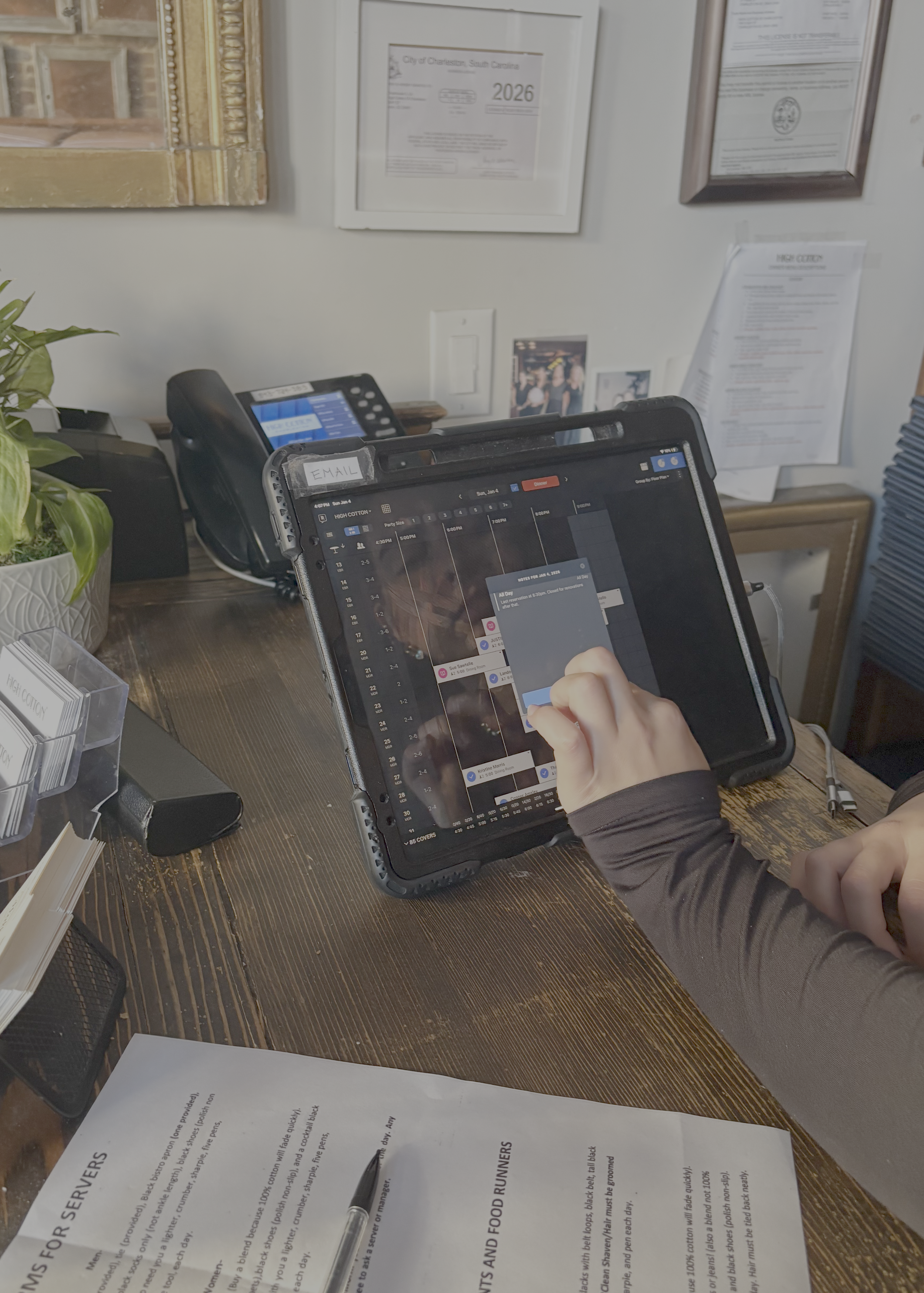
Raw Data to Main Takeaways
Synthesized raw interview recordings into main takeaways.
These unrefined takeaways served as the basis for user modeling.
Synthesis & User Modeling
Initial Research Hypothesis
Restaurant staff using hospitality platforms often face communication gaps and organizational pressures during service. This creates a high-stress environment for reservation managers and disrupts guest flow. By streamlining these internal communications, we can improve quality of service, reduce staff burnout, and increase overall restaurant revenue.
Affinity Diagram Development
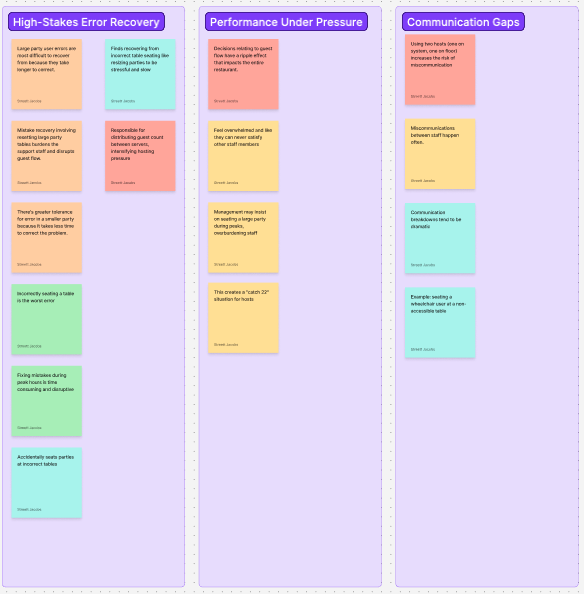
Organized and refined interview activity notes into eight clusters using an affinity diagram.
System Limitations
Reliability Issues
High-Stakes Error Recovery
Performance Under Pressure
Communication Gaps
Manual Efforts & Workarounds
Organizational Dynamics
Desired Improvements
Persona Synthesis
Outlined persona details based on interview findings to compose a persona narrative description.
Background
Goals
Behaviors
Character Archetype & Mental Modeling
Persona Narrative Description
Amelia is a diligent 20-year-old college student studying communication at the College of Charleston. On some of her days off from class, she works as a restaurant host in downtown Charleston. Her earnings as a host are mainly going toward paying for tuition, but she is also saving up for a trip to Mexico with her friends. Amelia values healthy relationships, community, and personal development by practicing a strong work ethic. She identifies hosting as a temporary role before transitioning to a career more focused on communication. Amelia enjoys hosting because it allows her to express her outgoing personality and reinforce the communication skills that will benefit her in her future career.
During peak hours at the host stand, Amelia has become more focused and calm than when she first started hosting. She's confident in managing the various responsibilities necessary to be an effective staff member and teammate. Amelia can simultaneously review waitlists and check in arriving guests. Amelia takes pride in being an approachable person who can pacify agitated guests waiting during busy periods. Sometimes, when the restaurant is exceedingly busy, she becomes especially frustrated when management overrides her seating decisions because it feels invalidating to her sense of professionalism. Amelia believes she can achieve a more stable lifestyle outside the hospitality industry and avoid emotional burnout stemming from management issues. Amelia is currently content as a host but is excited to transfer the skills she's learned to another career path.
Problem Statement Formulation
Formed my problem statement to guide the ideation phase.
Design Problem Statement: Restaurant staff using hospitality platforms need a way to overcome fragmented communication during high-intensity shifts to reduce burnout, as these gaps lead to interpersonal tension and a measurable decline in service quality.
Research Evolution
The Initial Hypothesis
Problem: Fragmented service results from obsolete user interfaces.
Focus: Visual aesthetics and button placement.
The Evidence-Based Discovery
Problem: Structural failures in the system's logic leave staff in cognitive disarray.
Focus: Socio-technical interdependencies and error recovery.
Methodological Reflection
During the initial discovery phase, I hypothesized that restaurant staff managing reservations encountered friction due to obsolete user interfaces. After the Affinity Mapping process, I reconceived the problem landscape. By organizing raw interview data into conceptual clusters, such as “High-Stakes Error Recovery” and “Manual Efforts & Workarounds,” I discovered that the core issue is more structural than surface-level.
The synthesis revealed a substantial gap between the system's setup and the user's reality. While I initially viewed fragmented communication as a chain of isolated glitches, the Diagram Clustering process illustrated a systemic failure that forced staff into a recurring state of cognitive disarray. As a result, this realization shifted my focus from simple UI fixes to a more extensive inquiry into socio-technical interdependencies.
This methodological pivot was instrumental in formulating my Design Problem Statement. It showed me that design insights are not exclusively found in the data. They also emerge through rigorous, evidence-based synthesis. Moving forward, I recognize that an integrated design system ought to prioritize the psychological and cognitive load on users, ensuring that digital tools support rather than invalidate hospitality professionals.
Problem Statement Evolution
Phase 1: Initial Hypothesis
Observation-Based: Focuses on surface-level communication gaps.
Initial Statement: "Restaurant staff... often face communication gaps..."
Primary Goal: Improve quality of service and revenue.
Phase 2: Design Problem Statement
Evidence-Based: Focuses on fragmented communication leading to tension.
Reformulated Statement: "Restaurant staff... need a way to overcome fragmented communication..."
Primary Goal: Mitigate staff burnout and psychological burden.
Ideation Process
Divergent Ideas
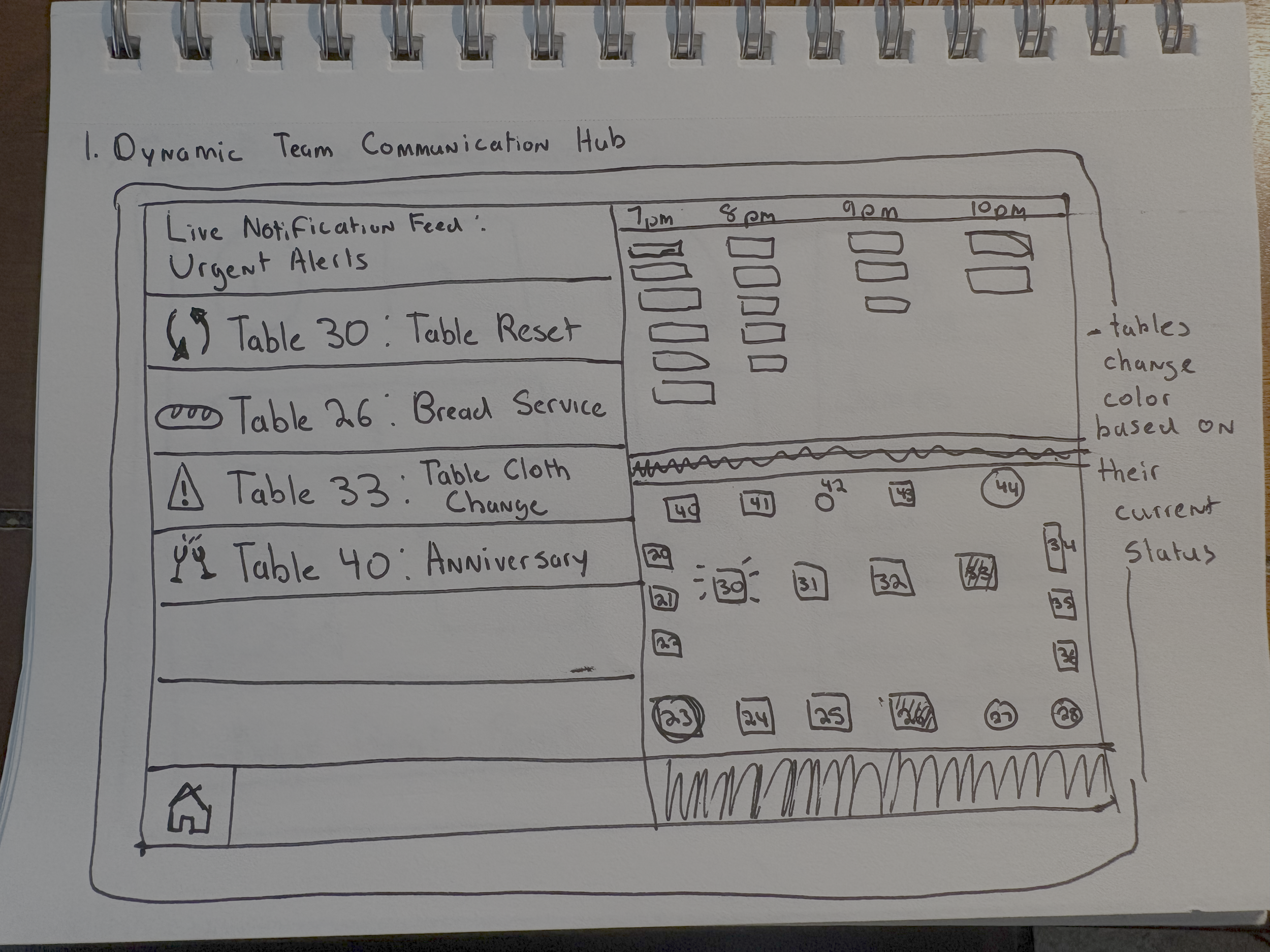
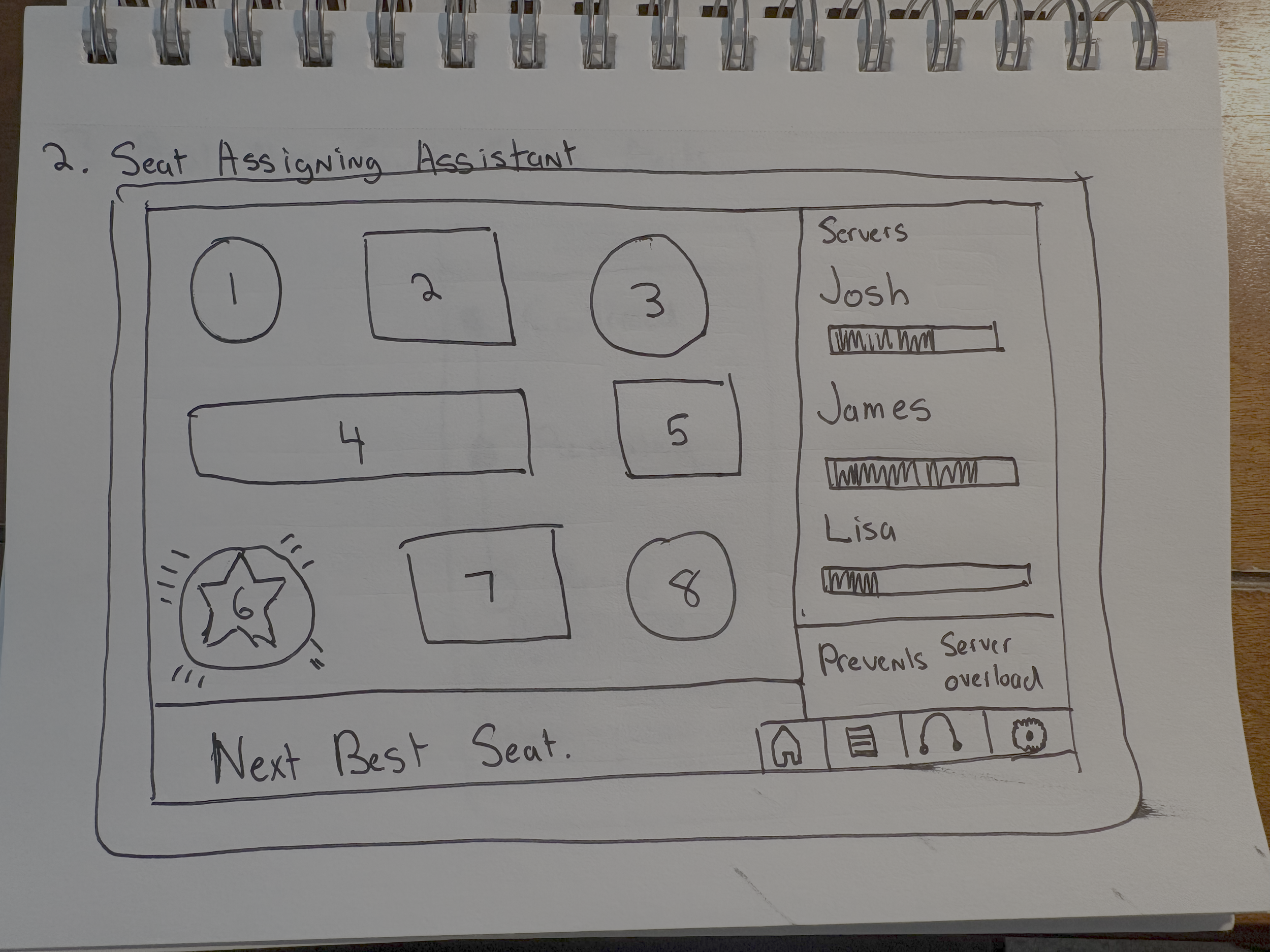
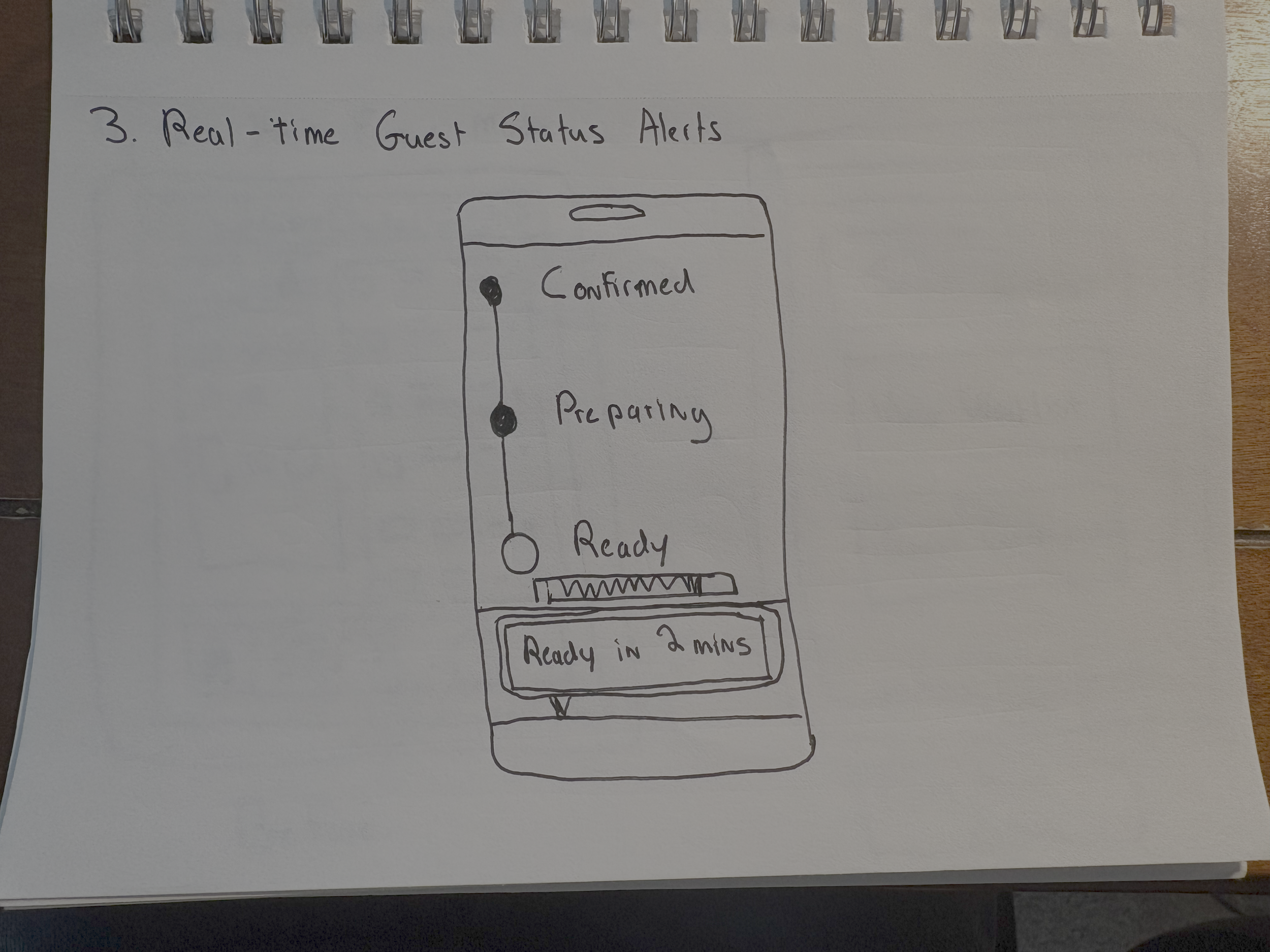
Ideated and sketched eight core design ideas addressing the design problem statement and supporting persona goals.
Dynamic Team Communication Hub
Seat Assigning Assistant
Real-time Guest Status Alerts
Peak Hours Focus Mode
Gamified Mentorship & Feedback Tracker
Pre-shift Preparation Checklist
Real-time Conflict Resolution Tips
Emotional Decompression Moments
Concept Convergence
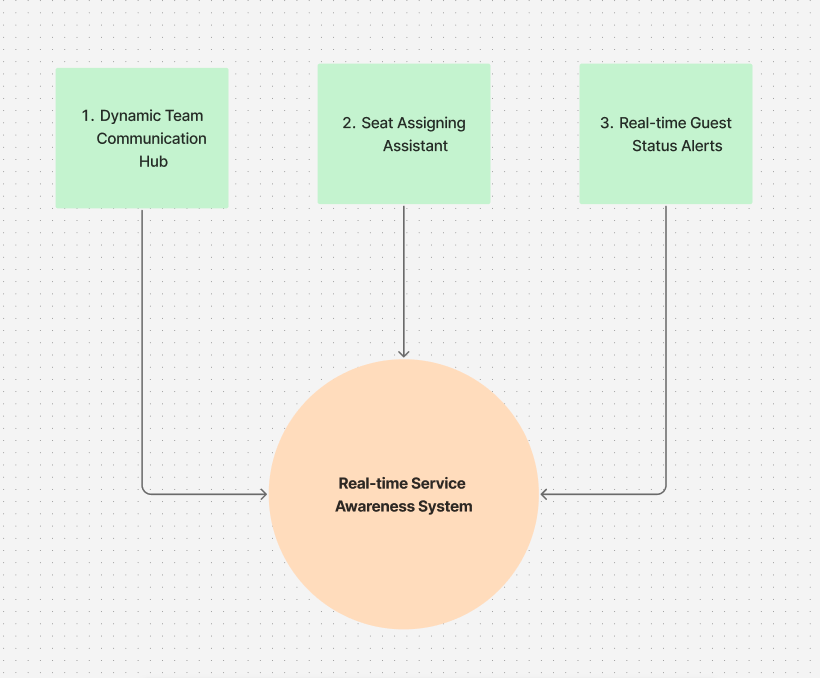
Synthesized ideas 1, 2, and 3 to develop a Real-time Service Awareness System design concept that more directly addressed the problem statement and addressed the persona goals.
A Real-time Service Awareness System aligns staff and guest expectations during high-intensity shifts, reducing burnout, preventing conflict, and improving service quality by creating a shared reality that varies by role.
Defining Basic Tasks & Flow
Task 1: Establish Situational Awareness During High-Intensity Shifts
(Primary / Foundational Task)
Task 2: Communicate Accurate, Confident Expectations to Guests
(Sequential - Follows Task 1)
Task 3: Make and Justify Seating Decisions Under Pressure
(Hierarchical Task - depends on Tasks 1 & 2)
Prototyping
Paper Prototype
Developed an interactive paper prototype to test basic tasks and critical features.
Overlay accessibility
Waitlist organization
UI gestures
System transparency
Key Takeaway: Testing revealed that users struggled with waitlist gestures, prompting a redesign of the waitlist overlay in the digital version.
Digital Prototype
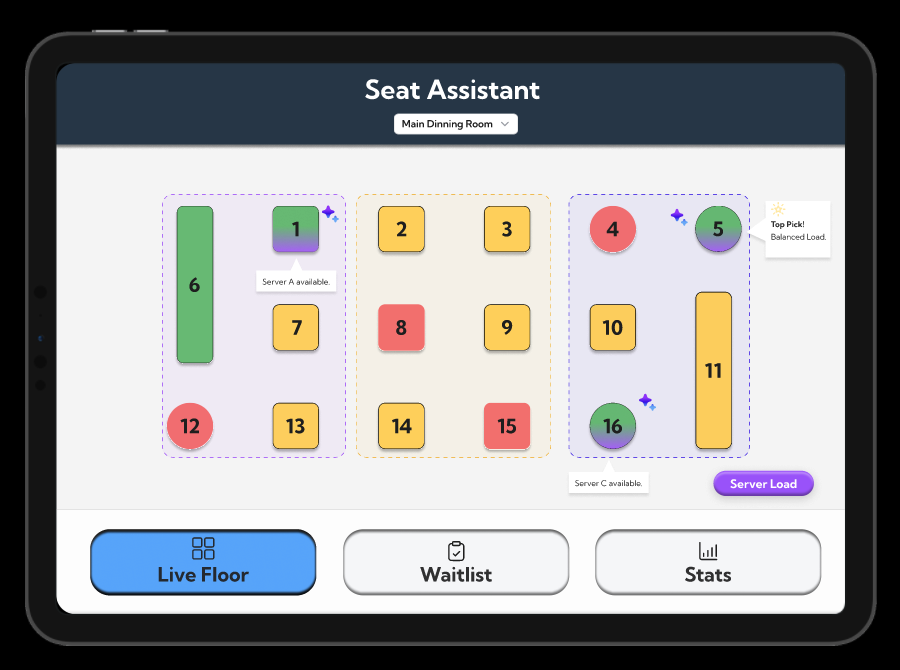
Created a high-fidelity digital prototype based on paper prototype feedback.
The high-fidelity prototype focuses on reducing "Cognitive disarray” by providing a unified view of floor status and guest wait times, allowing hosts to make confident decisions under pressure.
Supporting the Persona
The AI seating assistance specifically reduces Amelia’s high-stakes decision-making pressure by providing easily scanable seating recommendations with justifications.